
A phone call comes in. A family member was arrested last night. Now someone mentions a “first appearance,” and nobody in the family knows what that means. Is it a trial? Does the judge decide guilt? Can your loved one go home afterward?
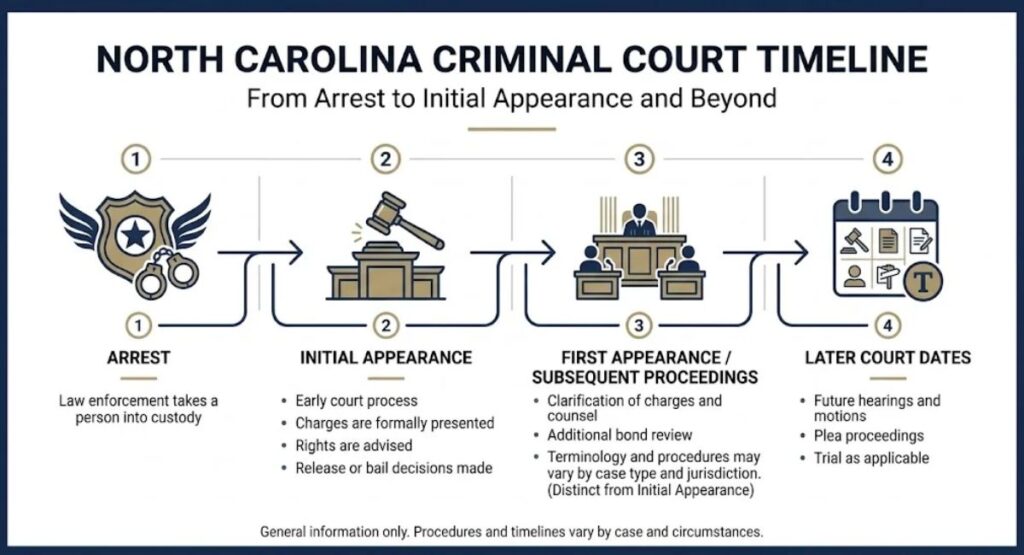
These are fair questions. The court process uses terms that sound alike. Many families mix them up. That confusion leads to missed steps and bad guesses.
This guide explains the first appearance in plain words. It covers who runs it, how fast it must happen, what gets decided, and how it differs from later court dates. The details here follow North Carolina law as of this writing. Rules change, so confirm anything important with the court or an attorney.
The Short Answer
A first appearance is an early court hearing after an arrest. A judge reviews the charges and the person’s release status. The person learns what comes next. It is not a trial. No one is found guilty or not guilty at this hearing.
In North Carolina, the process has two early steps that families often blur together. The first is the initial appearance before a magistrate. The second is the first appearance before a district court judge. Both matter. They are not the same thing.
Why Families Mix Up the Terms
Court language is not always consistent. Some people say “first appearance” for the magistrate hearing. Others say “initial appearance” for the judge hearing. News stories and online articles use the words in different ways.
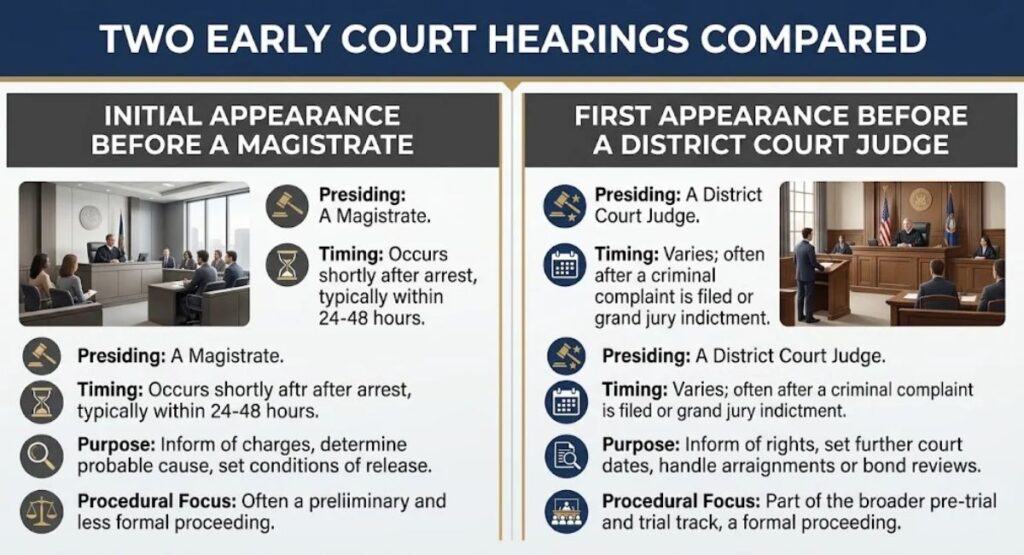
In North Carolina statutes, the terms have separate meanings:
- Initial appearance: The hearing before a magistrate, usually soon after arrest.
- First appearance: The hearing before a district court judge.
Knowing the difference helps you ask the right question. If you call the court, you can say which hearing you mean. Staff can then give a clearer answer.
Step One: The Initial Appearance Before a Magistrate
After an arrest, officers must bring the person before a magistrate without unnecessary delay. A magistrate is a judicial official who handles early steps in criminal cases. Magistrates work in every county. Many are available at all hours.
This is often the first time anyone reviews the arrest. It usually happens in a magistrate’s office at or near the jail. Some counties use video links.
What the Magistrate Does
The magistrate has a clear set of tasks. These include:
- Telling the person what the charges are
- Explaining the right to contact a lawyer and friends
- Explaining the general conditions for release
- Deciding whether probable cause supports the arrest, when the arrest happened without a warrant
- Setting release conditions, or ordering the person held
Probable cause is a legal standard. It means the facts give a reasonable basis to believe a crime happened and the person committed it. If the magistrate finds no probable cause for a warrantless arrest, the person must be released.
When the Hearing Can Be Delayed
Sometimes a person cannot take part right away. They may be unconscious or heavily intoxicated. They may be too disruptive to proceed. In those cases, the magistrate can order the person held and set the hearing for a later time. The law calls for a reasonable delay, not an open-ended one.
Who Else Can Conduct It
A magistrate normally handles it. The law also allows a judge, justice, or clerk of the General Court of Justice to conduct an initial appearance.
Step Two: The First Appearance Before a District Court Judge
The next step is the first appearance before a district court judge. This is the hearing most people mean when they ask about a first appearance in court.
Who Must Attend
North Carolina law requires this hearing for two groups:
- People charged with a crime that belongs in superior court, such as a felony
- People charged with misdemeanors who are held in custody
The hearing happens in the district where the crime is alleged to have taken place. The statute also says this appearance is not a critical stage of the case. That is a legal point. It means certain rights, like the right to a lawyer at critical stages, work differently here than at later steps.
How Fast It Must Happen
The timing rules are specific. For someone held in custody, the first appearance must take place within 72 hours of custody or at the first regular district court session in the county, whichever comes first.
There is one extension. If the courthouse is closed for more than 72 hours, such as over a long holiday weekend, the limit becomes 96 hours. Even then, an earlier regular session controls.
If the person is released before the hearing, the first appearance moves to the next district court session. The same is true if the person was never taken into custody.
People who receive a criminal summons get a court date on that paper. These deadlines do not apply to them in the same way.
Who Can Hold the Hearing
A district court judge normally presides. If no judge is available in time, the clerk of superior court may hold the hearing. If the clerk is not available, a magistrate may do it. Whoever conducts it has the same authority a district judge would have for this step.
Can the Hearing Be Combined?
Yes. A judge who handles the initial appearance can combine it with the first appearance. This can happen in smaller counties or when a judge is on hand. In that case, the family may see only one hearing.
Can the Person Skip It?
No. The defendant cannot waive the first appearance. A defendant who has a lawyer does not have to be present in person. The lawyer can attend for them. The hearing can also be continued to a set time if the defendant asks for that.
Initial Appearance vs. First Appearance: A Quick Comparison
This table puts the two hearings side by side.
| Feature | Initial Appearance | First Appearance |
| Who runs it | Magistrate, usually | District court judge, usually |
| Timing | Without unnecessary delay after arrest | Within 72 hours of custody, or the first regular session |
| Main purpose | Review charges, check probable cause, set release terms | Review the case status and release conditions in court |
| Who must attend | Anyone arrested | Felony defendants and jailed misdemeanor defendants |
| Can it be waived | No set waiver step | No, but a lawyer can appear for the defendant |
Keep in mind that practice differs from county to county. Local court calendars and staffing change how these hearings look in real life.
What Gets Decided at These Early Hearings
Families often hope for a final answer. Early hearings do not give one. They deal with process and release.
The Charges Are Reviewed
The person hears the charges. These come from the arrest paperwork or a warrant. Charges can change later. A prosecutor may add, reduce, or drop them as the case moves along.
Release Conditions Are Set or Reviewed
This is the most important part for most families. A judicial official decides if the person can be released and under what terms. The decision follows North Carolina’s pretrial release law.
The Right to a Lawyer Is Addressed
The person learns about the right to contact an attorney. Someone who cannot pay for a lawyer may ask the court about appointed counsel. The court may ask about income to decide this.
The Next Steps Are Announced
The person learns what comes next. This can include the date of the next court appearance. Families should write down every date.
How Pretrial Release Conditions Work in North Carolina
When a magistrate or judge sets conditions, the law gives a list of choices. Under the statute, the judicial official must impose at least one of these:
- An unsecured appearance bond for a set amount
- Release to a designated person or organization that agrees to supervise
- A secured appearance bond, backed by a cash deposit, a mortgage, or a solvent surety
- House arrest with electronic monitoring, which comes with a secured bond
The list changed recently. North Carolina repealed one older option, effective December 1, 2025. That option was the written promise to appear. If you read older articles that mention it, check the current statute.
Factors the Judge Considers
The law tells officials what to weigh. They must obtain a criminal history report and consider factors such as:
- The nature of the offense and the strength of the evidence
- Family ties, employment, and finances
- Length of time in the community
- Mental condition and any intoxication
- Past failures to appear in court
- Any other relevant evidence
Officials may use information that would not meet strict courtroom evidence rules. This is an early stage, so the process is faster and more flexible.
Different Rules for Different Charges
The statute treats certain cases in specific ways.
Non-violent offenses. The official starts with an unsecured bond or custody release. A move to a secured bond or house arrest requires findings, such as concern that release would not assure appearance or would endanger someone. The reasons must be put in writing. People with several prior convictions in the past ten years face a stricter rule and must receive a secured bond or house arrest.
Violent offenses. The law presumes that no condition will reasonably assure appearance and safety. If release is still granted for a first violent offense, a secured bond or house arrest is required. Later violent offenses can require house arrest where it is available.
Prior missed court dates. If a person failed to appear before, the official must follow stricter rules. These can include a higher secured bond than before.
Probation cases. For felony defendants on probation, the official must decide in writing whether the person is a danger to the public. Missing information can lead to a hold until the first appearance.
Citizenship checks. For certain charges, the official must try to determine citizenship or legal residency. This can include a short hold while authorities are queried.
This is a summary, not a full legal reading. A lawyer can explain how these rules apply to a specific case.
Conditions Can Change
Release orders are not always final. Magistrates and clerks can modify conditions until the first appearance. After that, a district court judge can modify them until the case is appealed or sent to superior court. Superior court judges take over after that point. Any judge can revoke release for good cause. The defendant can then ask for new conditions.
This matters for families. If a bond seems too high, a lawyer may ask for a review at the right time.
Release Terms in Plain Language
Legal terms can sound heavy. This table gives a simple translation.
| Term | Plain Meaning |
| Unsecured bond | The person owes money only if they miss court |
| Secured bond | Money or a guarantee must be posted before release |
| Custody release | Someone responsible agrees to supervise the person |
| House arrest | The person stays home with electronic monitoring |
| Surety | A guarantor, such as a bonding agent, backs the bond |
| Probable cause | A reasonable basis to believe a crime occurred |
| Continuance | A delay of a hearing to a later set time |
How the First Appearance Differs From Later Court Dates
Many families expect one big hearing. The real process has many steps. The first appearance is only an early step.
The First Appearance Is About Process
It deals with charges, release, counsel, and scheduling. It does not decide guilt. Evidence is not weighed in the way it is at trial.
Later Court Dates Move the Case Forward
After the first appearance, the case goes on. Later dates may include:
- Hearings to check on attorney status
- Hearings on motions
- A probable cause hearing or grand jury action in felony cases
- Plea discussions or negotiations
- A trial date
The exact steps depend on the charge and the court. A simple misdemeanor may move quickly. A felony takes longer and may move to superior court.
Trial Is a Separate Event
At trial, a judge or jury decides guilt based on evidence. That is far from a first appearance. Treat the first appearance as the starting line, not the finish.
What Families Should Know and Do
The first hearing happens fast. A little preparation helps.
Before the Hearing
- Confirm where your loved one is held. Our guide on how to find out if someone was arrested in Sampson County walks through the search steps.
- Gather basic facts. The checklist in information needed when someone is arrested lists what to have ready for calls.
- Contact an attorney if you can. A lawyer may know the local court well.
- Ask the clerk of court for the date and time of the hearing.
On the Day
- Arrive early if the hearing is open to visitors.
- Dress neatly and stay calm.
- Silence your phone.
- Bring a pen and paper for notes.
- Follow the courtroom rules posted at the door.
Not every first appearance allows family to attend in person. Some counties use video. Ask staff how it works in your area.
After the Hearing
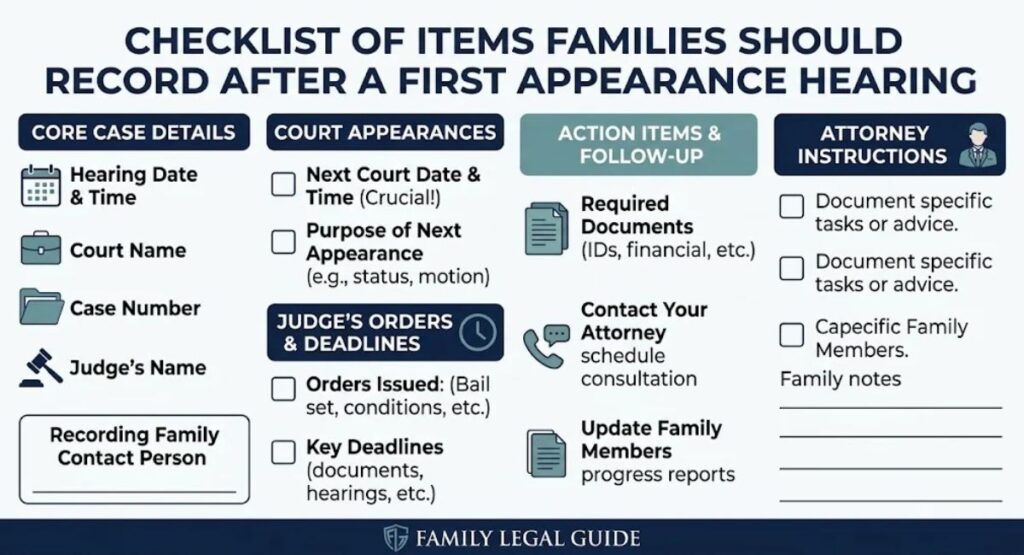
- Write down the release conditions.
- Write down every future court date.
- Ask what paperwork, if any, the family needs to handle.
- Decide on release steps if a secured bond is required.
Real Scenarios
These examples are illustrations only. They show how the process can feel in real life.
Scenario 1: Arrested on a Friday Night
A man is arrested late Friday. He sees a magistrate within hours. The magistrate sets a secured bond. His family cannot post it that night. The first appearance happens at the next regular district court session. The judge reviews the case, and the next date is set.
Lesson: Weekend arrests often mean waiting. Plan for timing rules and court schedules.
Scenario 2: Released Before the Hearing
A woman is arrested for a misdemeanor. She posts bond that evening. Because she is released, her first appearance shifts to the next district court session. She attends with her lawyer and learns the next date.
Lesson: Release does not cancel court. The date still matters.
Scenario 3: A Lawyer Appears Instead
A defendant has an attorney. The attorney tells the court the defendant will not attend. The court allows the lawyer to appear on the defendant’s behalf. The hearing goes forward, and the date is set.
Lesson: A represented defendant may not need to appear in person. Always confirm this with the lawyer.
Common Mistakes to Avoid
Stress leads to errors. Watch for these.
Treating It Like a Trial
Do not expect a verdict. Do not argue the facts of the case in the hallway. Save that for the lawyer.
Missing the Date
A missed court date can lead to new problems, including an order for arrest. Write each date down and confirm it with the clerk.
Relying on Outdated Information
Court rules and statutes change. The written promise to appear is one example. Check current sources before you act on old advice.
Discussing the Case on Jail Calls
Calls from jails are often recorded. Keep talks to health, family, and logistics.
Ignoring Release Terms
Release conditions have rules. Breaking them can lead to a revoked release. Read the order carefully and follow it.
How Bail Bonds Fit Into the Picture
If the court sets a secured bond, the family has two main paths. They can pay the full amount to the court. Or they can work with a licensed bail agent, who charges a fee to post the bond.
Different bond types apply to different needs. A criminal court bond covers charges tied to criminal cases. An appearance bond in North Carolina guarantees the person will return to court.
Arrests do not follow office hours. If you need help late at night or on a holiday, 24/7 bail bonds NC service can start the process when other offices are closed.
What a Co-Signer Takes On
Most bonds need a co-signer. This person agrees to be responsible if the defendant misses court. The co-signer may owe the full bond amount in that case.
Before you sign, ask:
- What is the fee, and when is it due?
- What other costs could apply?
- What happens if a court date is missed?
- How will I learn about court dates?
Read every page. Make sure the agent is licensed in North Carolina.
For a broader view of the steps after an arrest, read our guide on what happens after an arrest in North Carolina.
Frequently Asked Questions
What is a first appearance in North Carolina court?
It is an early hearing before a district court judge after an arrest. The judge reviews the charges and release status. It is not a trial, and guilt is not decided.
How soon is the first appearance after arrest?
For a person in custody, it must happen within 72 hours or at the first regular district court session, whichever comes first. The limit can extend to 96 hours if the courthouse is closed for more than 72 hours.
Is the initial appearance the same as the first appearance?
No. The initial appearance is before a magistrate soon after arrest. The first appearance is before a district court judge. In some cases they are combined.
Who sets the bond?
A magistrate or judge sets release conditions under North Carolina’s pretrial release law. The official weighs the charge, history, and other factors.
Can I bail someone out before the first appearance?
Often yes, if release conditions allow it. If the person is released first, the first appearance moves to the next district court session.
Does the defendant have to attend?
A defendant with a lawyer does not have to appear in person. The lawyer can appear. A defendant cannot waive the first appearance itself.
Is a lawyer required at the first appearance?
The statute says the first appearance is not a critical stage. Still, a lawyer can explain options and may be able to speak for the defendant. Ask the court about appointed counsel if cost is a concern.
What if the bond seems too high?
A lawyer may ask the court to review the conditions. Magistrates, clerks, and judges can modify orders at different stages. Timing matters, so act quickly.
Does a first appearance mean the person is guilty?
No. An arrest and a first appearance are early steps. Every person is presumed innocent until proven guilty in court.
Where to Check the Law Yourself
You can read the statute text directly. North Carolina’s General Statute 15A-601 covers the first appearance before a district court judge. The same website carries the related sections on the initial appearance and pretrial release. Reading the source can help when you hear conflicting advice.
Your Next Steps
Here is a short recap you can save:
- Confirm where your loved one is held.
- Gather the full legal name, birth date, and booking number.
- Ask the jail or clerk when the first appearance will happen.
- Contact an attorney for guidance.
- Write down release conditions and all court dates.
- Decide how to handle a secured bond, if one is set.
- Plan to attend every future hearing.
Go one step at a time. Most families feel better once they know what each hearing is for.
Final Words
A first appearance is an early step in a North Carolina criminal case. A magistrate handles the initial appearance. A district court judge handles the first appearance. Together they review the charges, address the right to counsel, and set or review release conditions. Neither decides guilt. Later court dates carry the case forward.
Laws change, so check current sources and talk to an attorney about your situation. If a secured bond is set and you need help with release, a licensed local agent can explain the options. Freedom Fast Bail Bonds helps North Carolina families with bail bond service at all hours. Call today and ask about the next step for your loved one.